What Is a Perp DEX Aggregator?
A complete guide to Perp DEX aggregators — decentralized execution layers that aggregate perpetual futures liquidity across blockchains, optimize trade routing, and enable unified margin trading.
The Meta-Liquidity Execution Layer of On-Chain Perpetual Markets
A Perp DEX Aggregator is a non-custodial derivatives execution layer that aggregates perpetual futures liquidity across multiple decentralized exchanges and blockchains and routes leveraged positions to optimize price, depth, slippage, fees, funding, and margin efficiency.
Rather than trading on a single perpetual DEX with isolated liquidity and collateral, traders access a unified execution surface that dynamically selects and executes across the optimal venues and chains.
What is perp DEX aggregator?
A perp DEX aggregator is a decentralized protocol that virtualizes and routes perpetual futures liquidity from multiple on-chain trading venues and chains into a single derivatives execution surface, enabling optimized leveraged trading without custody of user funds.
Why Perp DEX Aggregators Exist
By 2026, on-chain perpetual trading is structurally fragmented across:
Multiple protocol designs (pooled liquidity, vAMM, orderbook)
Multiple chains (Ethereum L2s, Solana, app-chains)
Multiple isolated margin systems
This fragmentation produces three systemic inefficiencies.
1. Liquidity fragmentation
Each perp venue has its own depth curve and spreads.
2. Capital fragmentation
Collateral is siloed per venue and chain.
3. Execution inefficiency
Traders must manually choose where to trade.
Perp DEX aggregators resolve these by converting fragmented markets into a synthetic global derivatives market.
Perp Aggregators as Liquidity Abstraction Layers
Perpetual DEX liquidity is structurally fragmented across multiple architectures, chains, and market designs, including AMM-based vaults, hybrid risk engines, and central limit order books. Each venue exposes liquidity through different pricing mechanisms, margin systems, and execution semantics.
A perp aggregator acts as a liquidity abstraction layer that normalizes this heterogeneity into a unified execution environment. Instead of interacting directly with individual venues, the trader interfaces with a meta-execution layer that:
• indexes liquidity across multiple perp venues
• normalizes pricing and margin models
• simulates execution impact across venues
• routes orders to the optimal execution path
Through this abstraction, fragmented liquidity is transformed into three core primitives:
Unified Virtual Orderbook
Liquidity from heterogeneous venues is mapped into a synthetic orderbook representation, allowing the system to compare execution paths across fundamentally different market structures.
Synthetic Aggregated Depth
The aggregator constructs an aggregated depth profile by modeling the executable size across venues, accounting for slippage curves, vault inventory, and orderbook liquidity.
Single Execution Surface
Traders interact with a single trading interface while the routing layer dynamically distributes order flow across venues and chains.
How a Perp DEX Aggregator Works
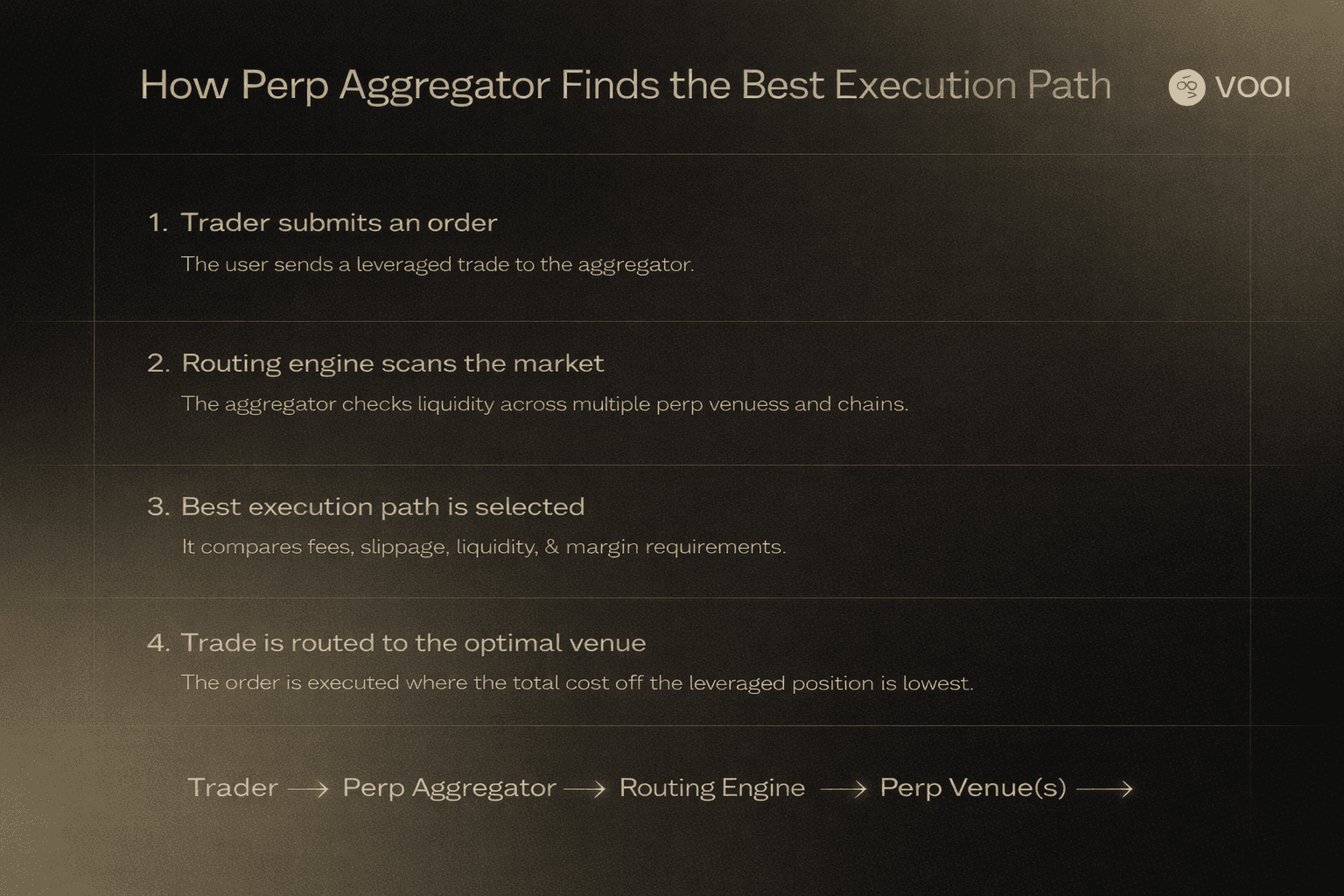
The aggregator evaluates available liquidity across venues and chains and selects the execution path that minimizes total position cost under leverage and margin constraints.
Perp Routing: A Constrained Optimization Problem
Unlike spot swaps, perpetual routing must optimize multi-dimensional cost.
Total execution cost includes:
Entry price
Slippage / market impact
Trading fees
Funding trajectory
Margin utilization
Liquidation risk
Cross-chain latency risk
Therefore perp aggregation is a derivatives-aware optimization problem, not just price routing.
Core Architecture of a Perp DEX Aggregator
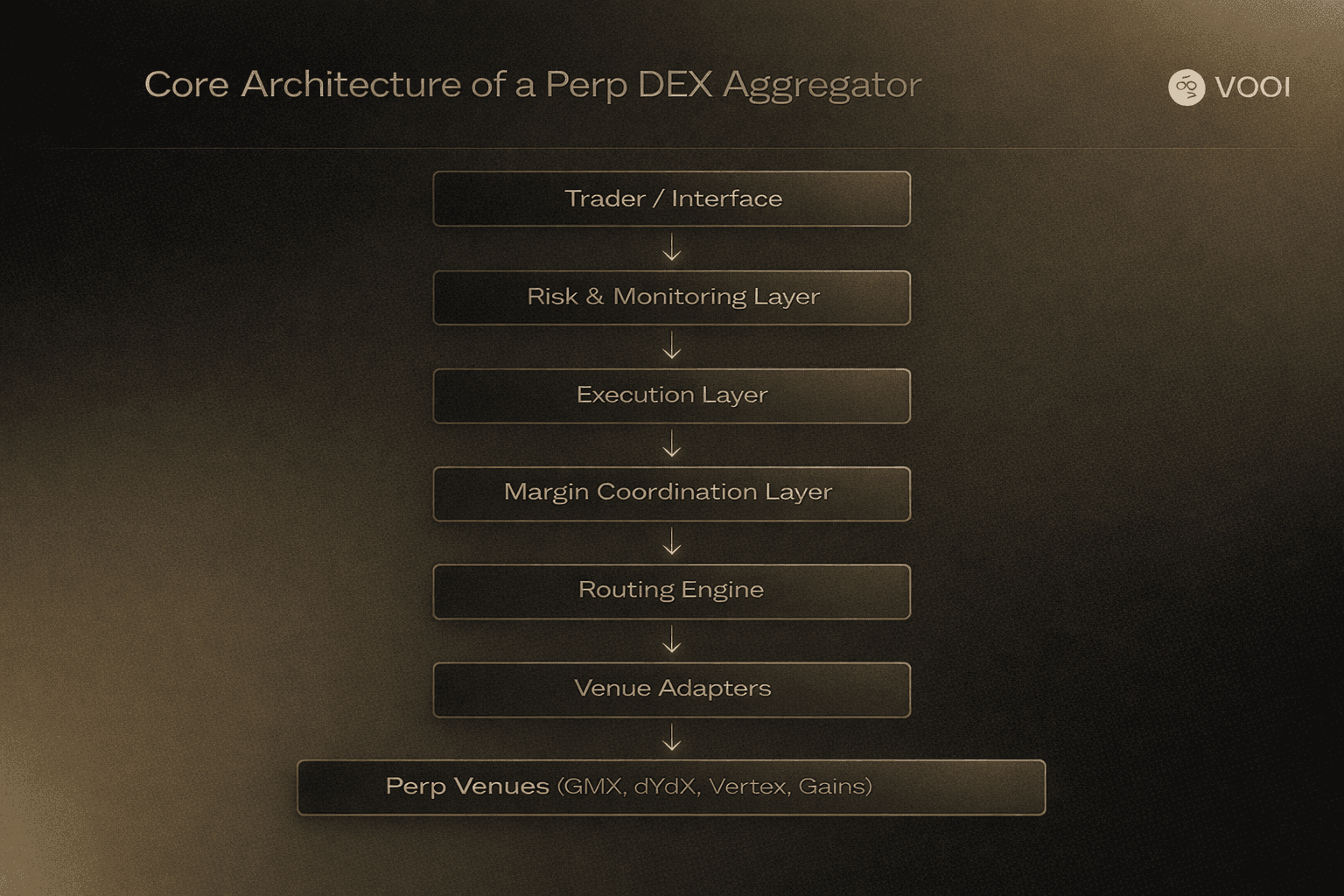
A production-grade perp aggregator is a multi-layer execution system that unifies fragmented derivatives liquidity across venues and chains.
1. Venue Adapters
Adapters normalize heterogeneous perp venues into a common execution schema:
pricing & slippage models
margin and collateral rules
funding mechanics
fee structures
liquidation logic
This abstracts protocol-specific logic behind a unified interface.
2. Routing Engine
The core optimization layer. Key capabilities:
multi-venue routing
order splitting
funding-aware execution
slippage minimization
dynamic re-routing
3. Margin Coordination Layer
Manages risk across venues:
collateral accounting
exposure aggregation
liquidation awareness
cross-venue netting
Advanced systems converge toward a unified margin.
4. Execution Layer
Handles execution reliability:
multi-venue settlement
partial fills
failure recovery
atomicity & cross-chain execution
5. Risk & Monitoring Layer
System-wide risk control:
liquidation thresholds
funding exposure
collateral utilization
venue correlation risk
oracle divergence
Perp Liquidity Models: Pool-Based vs Orderbook-Based
Perpetual DEX liquidity today is built on two fundamentally different market structures: pool-based AMMs and orderbook-based exchanges.
Each model solves the liquidity problem differently and has distinct implications for pricing, spreads, and risk management.
Perp aggregators play a key role because they can combine both liquidity types into a single execution layer.
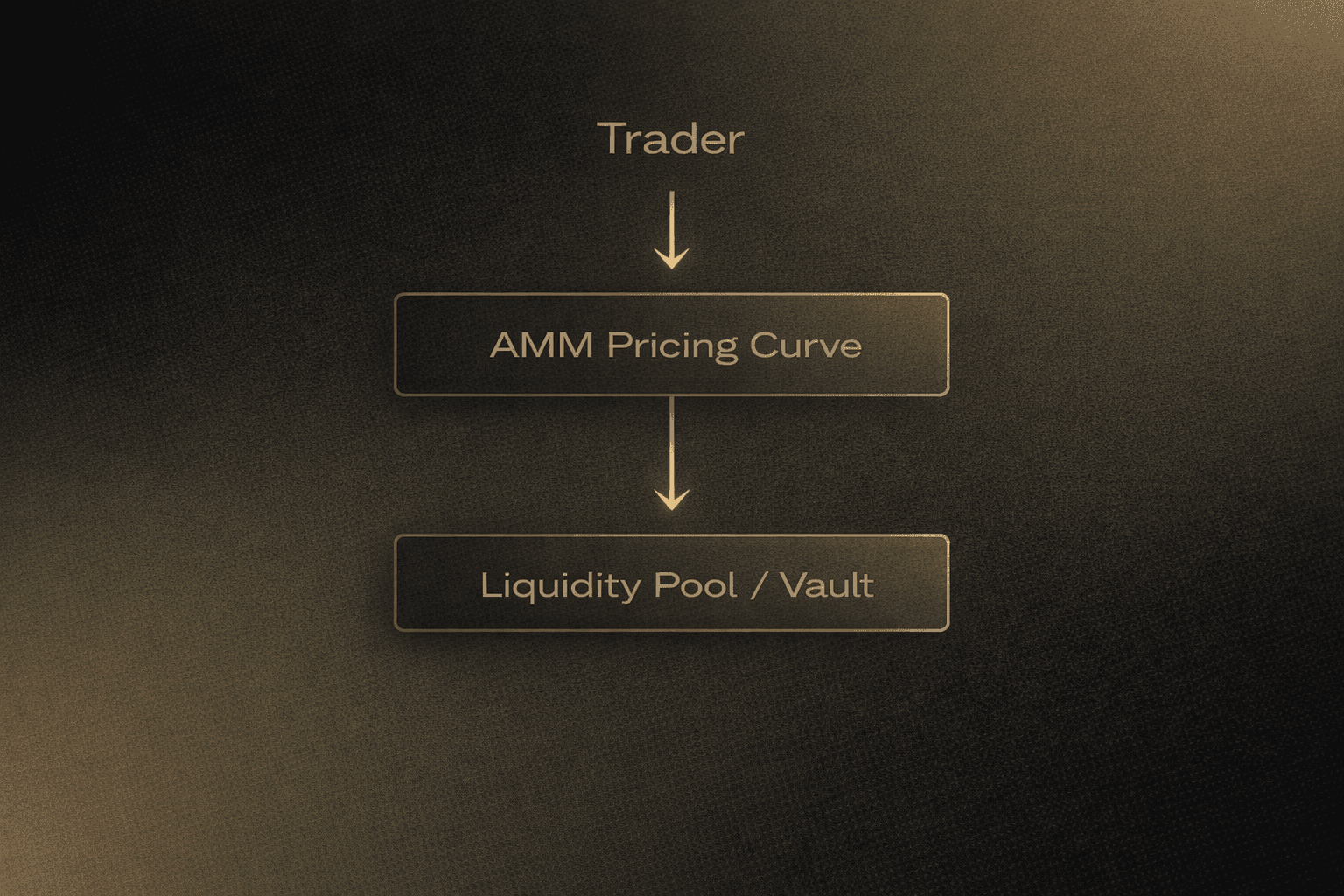
Pool-Based Perps (AMM / Vault Model)
Examples include platforms like GMX, Gains Network, and Perpetual Protocol.
These protocols rely on liquidity pools or vaults rather than traditional market makers. Traders interact with the protocol directly, and prices are derived from AMM curves and oracle inputs. Instead of matching buyers and sellers, the protocol itself acts as the counterparty to trades.
Key characteristics
Liquidity is synthetic and protocol-backed
Pricing is derived from AMM formulas + oracle feeds
Inventory risk is absorbed by the protocol or LP vaultSpreads can widen during high volatility
CLOB-Based Perps (Orderbook Model)
Examples include dYdX, Aevo, and Vertex Protocol.
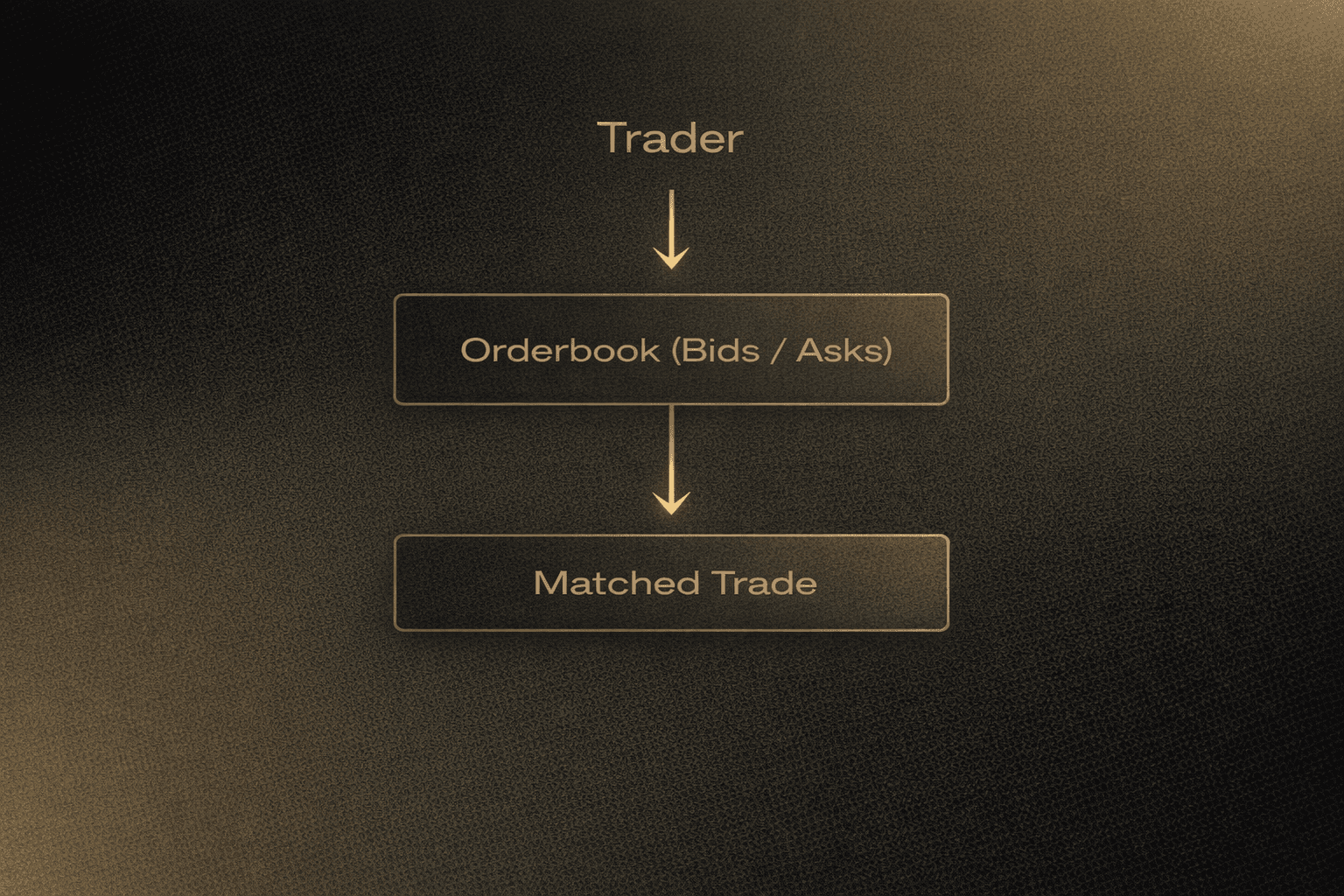
These platforms replicate the central limit order book (CLOB) structure used by traditional exchanges. Trades occur when buy and sell orders match. Liquidity is typically provided by professional market makers rather than passive LPs.
Key characteristics
Liquidity comes from active market makers
Tighter spreads when liquidity is deep
Higher price precision
Liquidity strongly depends on order flow and maker incentives
Feature | Pool-Based Perps | CLOB-Based Perps |
Liquidity Source | Protocol vaults / LP pools | Market makers |
Pricing | AMM curves + oracles | Orderbook price discovery |
Spread Behavior | Wider during volatility | Usually tighter |
Capital Efficiency | Moderate | High with active makers |
Examples | GMX, Gains Network, Ostium | Hyperliquid, Lighter, Orderly, Extended, edgeX, Grvt |
Unified Margin
In most DeFi derivatives platforms today, collateral is isolated per protocol. This means traders must manually move funds between venues.
Unified margin solves this problem.
Instead of locking collateral separately on each exchange, a trader uses one shared collateral pool that supports positions across multiple venues.
What unified margin enables
A single collateral pool
Positions opened across multiple exchanges
Automatic risk netting between positions
Benefits
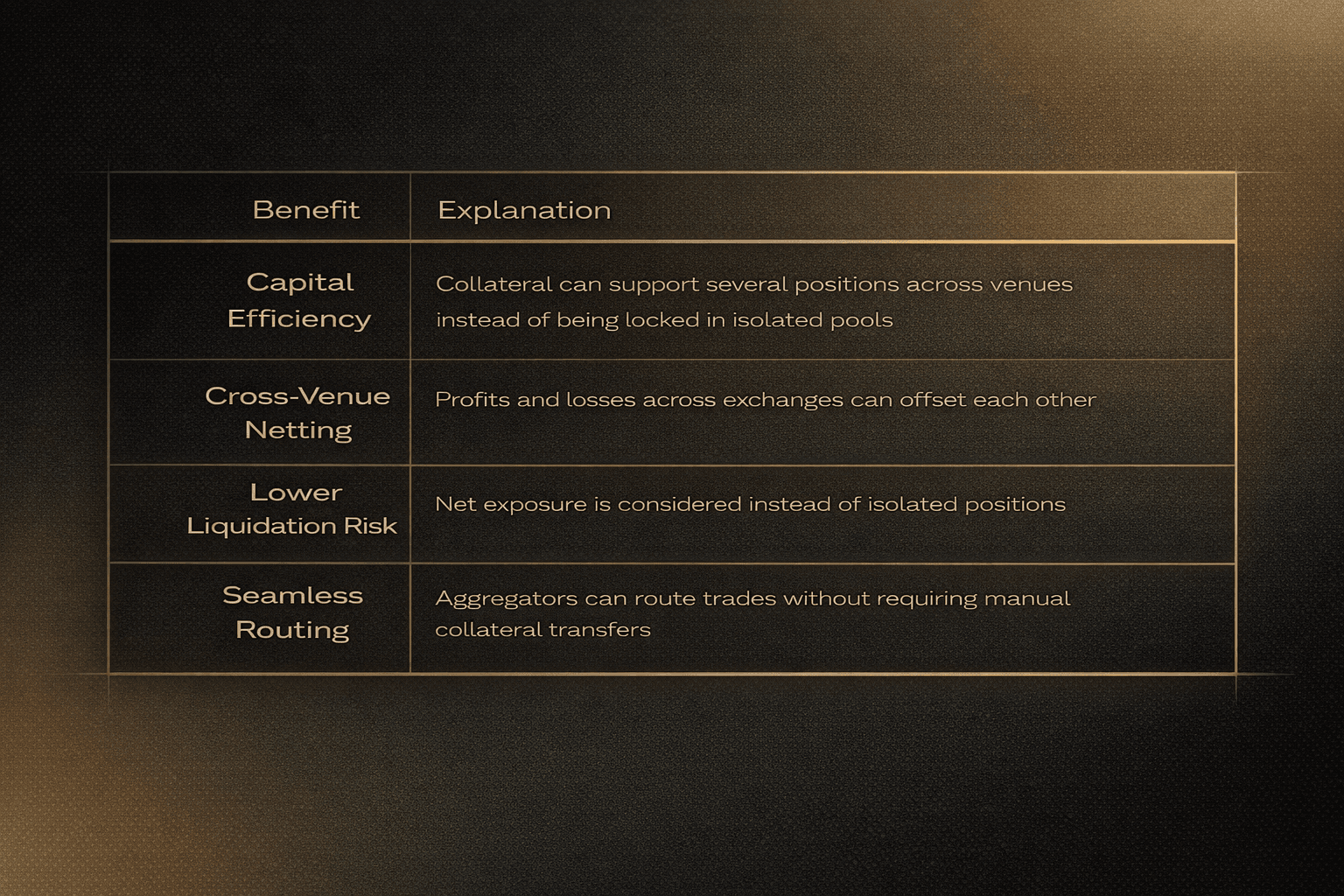
Unified margin effectively converts fragmented derivatives venues into a single synthetic exchange layer.
When combined with perp aggregators and cross-venue routing, this architecture allows traders to access liquidity across multiple protocols without fragmenting capital or managing collateral manually.
Cross-Chain Perp Aggregation
Perpetual liquidity in DeFi is not only fragmented across venues — it is also distributed across multiple blockchains. For example, different derivatives exchanges operate on different ecosystems.
This introduces a new layer of complexity for aggregators.
They must coordinate:
Collateral location across chains
Bridge latency vs liquidation windows
Oracle price consistency
Cross-chain risk exposure
Because leveraged positions can liquidate within seconds, cross-chain perp execution requires extremely careful risk coordination. This is why cross-chain perp aggregation is considered one of the hardest infrastructure problems in DeFi derivatives.
Perp Aggregator vs Single Perp DEX
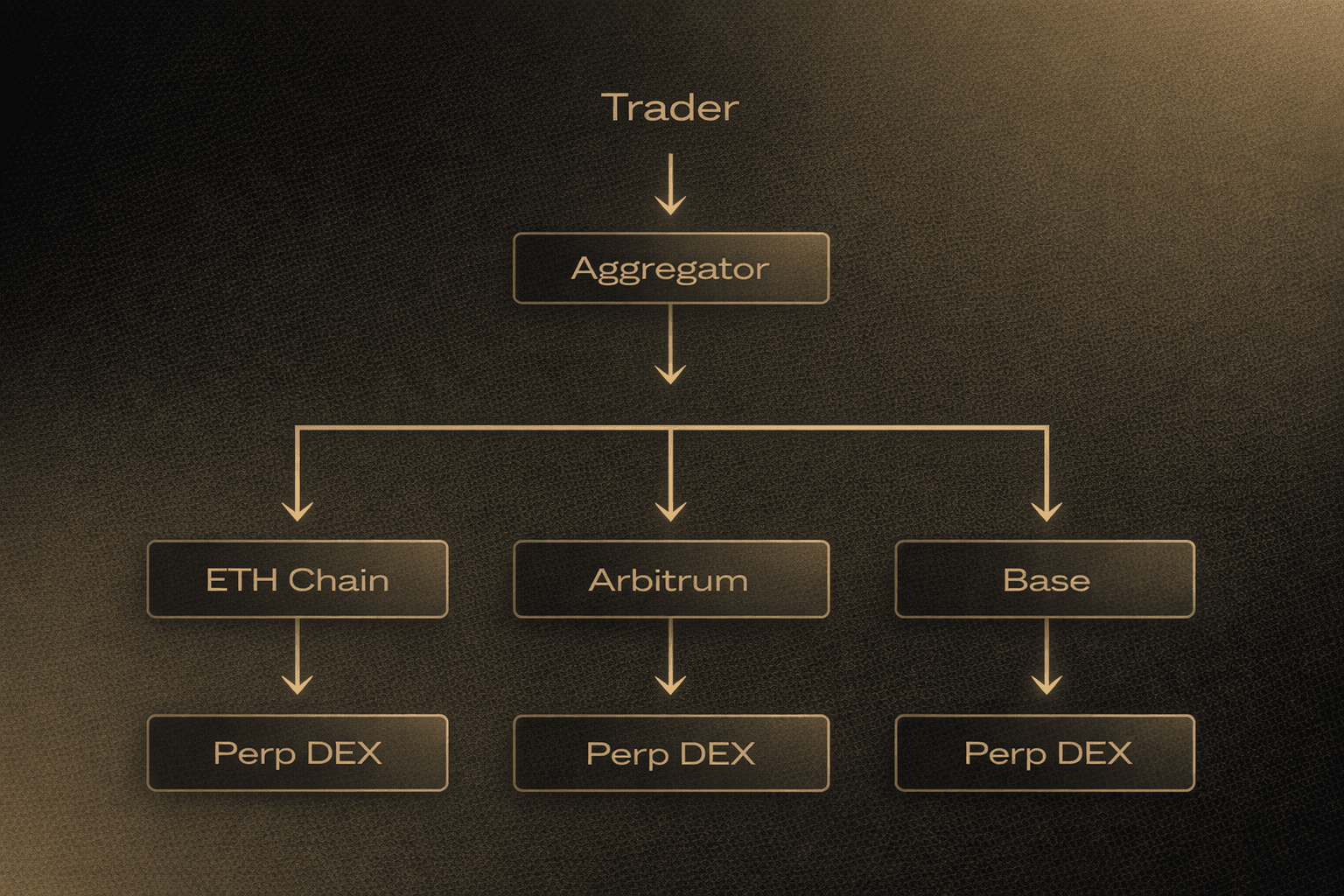
Traditional DeFi derivatives trading happens on one exchange at a time. Aggregators change this by routing orders across multiple venues simultaneously.
Feature | Perp Aggregator | Single Perp DEX |
Liquidity | Aggregated across venues | Local liquidity only |
Routing | Cross-venue execution | Single venue |
Chains | Multi-chain access | Chain-specific |
Slippage | Lower | Higher for large orders |
Capital Efficiency | Higher | Limited |
Aggregators therefore function as meta-exchanges built on top of existing derivatives venues.
As liquidity spreads across many protocols and chains, direct trading on a single venue becomes increasingly inefficient. Perp aggregators solve this fragmentation by acting as:
Liquidity abstraction layers
Derivatives execution engines
Cross-venue routers
Margin coordination systems
What began as a simple routing tool is rapidly evolving into core infrastructure for on-chain leverage markets.
Intent-Based Perpetual Execution
The next generation of perp aggregators will likely adopt intent-based trading. Instead of specifying how to execute a trade, the user simply defines the desired outcome. Example intent:
“Long BTC $5M notional with ≤ 10 bps slippage.”
The system then automatically determines:
the best venue
the optimal chain
the margin source
the execution path
This transforms derivatives trading from manual execution into declarative trading.
Key Takeaway
A perp DEX aggregator can be understood as a meta-order router for on-chain leverage.
It unifies fragmented perpetual liquidity, trading venues, and collateral sources into a single optimized execution layer. As perpetual markets expand across chains, perp aggregators are likely to become the primary execution infrastructure of decentralized derivatives trading.
FAQ
What is a perp DEX aggregator?
A perp DEX aggregator is a decentralized execution layer that routes perpetual futures trades across multiple DEX venues and chains to optimize price, liquidity, funding, and margin efficiency.
How does a perpetual DEX aggregator work?
It integrates multiple perp exchanges through adapters, evaluates liquidity and costs via a routing engine, and executes trades on the optimal venue or across multiple venues.
Why are perp aggregators needed?
Perpetual liquidity and collateral are fragmented across protocols and chains. Aggregators unify access and improve execution efficiency.
What is aggregated perpetual liquidity?
The combined effective trading depth sourced from multiple perpetual DEXs through a single routing layer.
How is perp aggregation different from spot aggregation?
Perp aggregation must optimize funding, leverage, and liquidation risk in addition to price and slippage.
What is a unified margin?
A single collateral pool supporting positions across multiple venues and chains without manual collateral transfers.
Are perp aggregators exchanges?
They function as synthetic exchanges built on top of multiple perp venues rather than hosting liquidity themselves.
Do perp aggregators custody funds?
No. Most are non-custodial; funds remain in user wallets or underlying protocols.
Can perp aggregators reduce trading costs?
Yes. They optimize venue selection, liquidity depth, and funding rates to reduce total position cost.
Can aggregators split orders?
Yes. Advanced routing engines distribute orders across venues to reduce market impact.
What risks exist when using perp aggregators?
Smart contract risk, oracle divergence, venue risk, cross-chain latency, and liquidation mechanics.
Who should use perp aggregators?
Professional traders, high-notional traders, multi-chain users, and execution-sensitive strategies.
Are perp aggregators the future of DeFi derivatives?
Yes. As liquidity fragments across chains, aggregation becomes the dominant execution model.

Reese Mason
Technical writer at VOOI