VOOI: MCP Execution Layer
Learn how the VOOI MCP Server aggregates perpetual futures liquidity across exchanges, enabling AI agents and automated strategies to trade derivatives through a unified execution layer.
VOOI MCP Server
Execution Layer for Perpetual Trading
Perpetual futures are the largest liquidity surface in crypto. But trading infrastructure is fragmented across hundreds of venues — each with its own margin system, order routing, liquidity, and APIs.
For automated systems and AI agents, this fragmentation creates a major barrier. Every exchange must be integrated separately, liquidity must be discovered manually, and margin must be managed across venues.
VOOI solves this by exposing aggregated perpetual markets through a single MCP interface.
Instead of integrating multiple exchanges, agents connect once to the VOOI MCP server and access perpetual trading across multiple venues through a unified execution layer.
What is MCP in Trading?
Model Context Protocol (MCP) is a standard that allows AI agents to interact with external systems through structured tools and APIs. In practice, an MCP server exposes actions an agent can perform. For financial infrastructure these actions might include:
bridging assets
executing swaps
managing liquidity
trading derivatives
When applied to trading, MCP becomes the interface between AI agents and financial markets. For perpetual markets, this interface must support:
trade execution
margin management
market context
liquidity routing
In other words, MCP turns financial infrastructure into programmable tools for autonomous systems.
For trading, this interface needs to go beyond simple market access. It must provide execution, liquidity routing, and margin management. VOOI exposes exactly these capabilities through its MCP server for perpetual markets.
The Problem: Fragmented Perpetual Markets
Perpetual liquidity is not located in one place. It’s distributed across multiple exchanges such as Hyperliquid, Orderly, Aster, Lighter and others. Each venue has different liquidity, spreads, and margin requirements. If a developer wants to build a trading agent today, they typically need to:
integrate each exchange API
normalize market data across venues
manage margin separately
route orders manually
This quickly becomes complex infrastructure work rather than trading logic. The agent spends more time dealing with exchange mechanics than actually trading.
What the VOOI MCP Server Provides
The VOOI MCP server gives agents access to aggregated perpetual markets through one interface. Instead of interacting with individual exchanges, agents use VOOI as the execution layer. Core capabilities include:
Aggregated Perpetual Liquidity
Access multiple perpetual exchanges as a single market. Liquidity from venues such as:
Hyperliquid
Orderly
Aster
Lighter
is aggregated and routed through one execution interface.
Cross-Venue Execution
Orders are automatically routed to the venue providing the best execution. Agents do not need to:
select exchanges
compare liquiditymanage venue-specific routing
VOOI handles execution across venues.
VOOI MCP Use Cases
AI Trading Agents
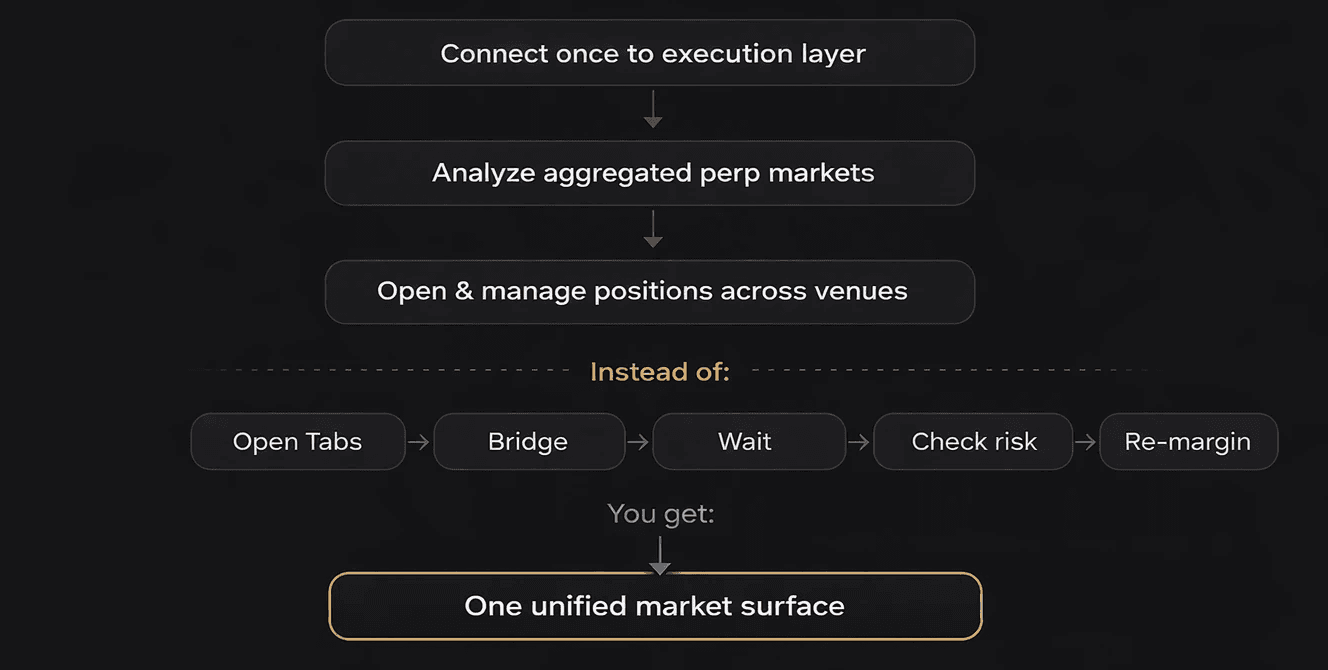
Autonomous trading agents require predictable execution and unified market access. Without aggregation they must integrate multiple exchanges and manage fragmented liquidity. Using the VOOI MCP server, an agent can:
connect once to the execution layer
analyze aggregated perp markets
open and manage positions across venues
The agent interacts with one market surface instead of many exchanges.
Automated Trading Strategies
Quant strategies often need access to multiple venues to capture liquidity or arbitrage opportunities. Instead of building integrations for each exchange, developers can run strategies through the VOOI MCP server. Typical workflows include:
cross-venue arbitrage
liquidity routing strategiesmarket making across venues
All executed through a unified trading API.
Multi-Venue Risk Management
Fragmented margin systems make it difficult to manage risk across perpetual exchanges.
The VOOI MCP server allows automated systems to:
monitor positions across venues
rebalance margin dynamically
adjust exposure across liquidity sources
This enables coordinated portfolio management across the perp ecosystem.
Trading MCP as the Execution Layer of DeFi
As MCP moves from capital movement to capital deployment, the core interaction point shifts to the execution layer of perpetual markets, where leverage, liquidity, and risk transfer concentrate. Any agentic trading system ultimately operates at this layer, making the MCP server that aggregates perp execution the primary interface between agents and derivatives markets. This is the role of perp aggregators — the execution infrastructure provided by VOOI.
Why Aggregators Become MCP Servers
MCP works best when interacting with normalized infrastructure. Direct protocol integrations require agents to handle:
different APIs
different margin systems
different execution mechanics
Aggregators already solve this problem by unifying fragmented systems into a single interface. This is why MCP naturally attaches to aggregation layers in DeFi. The pattern has already appeared in other areas of the ecosystem.
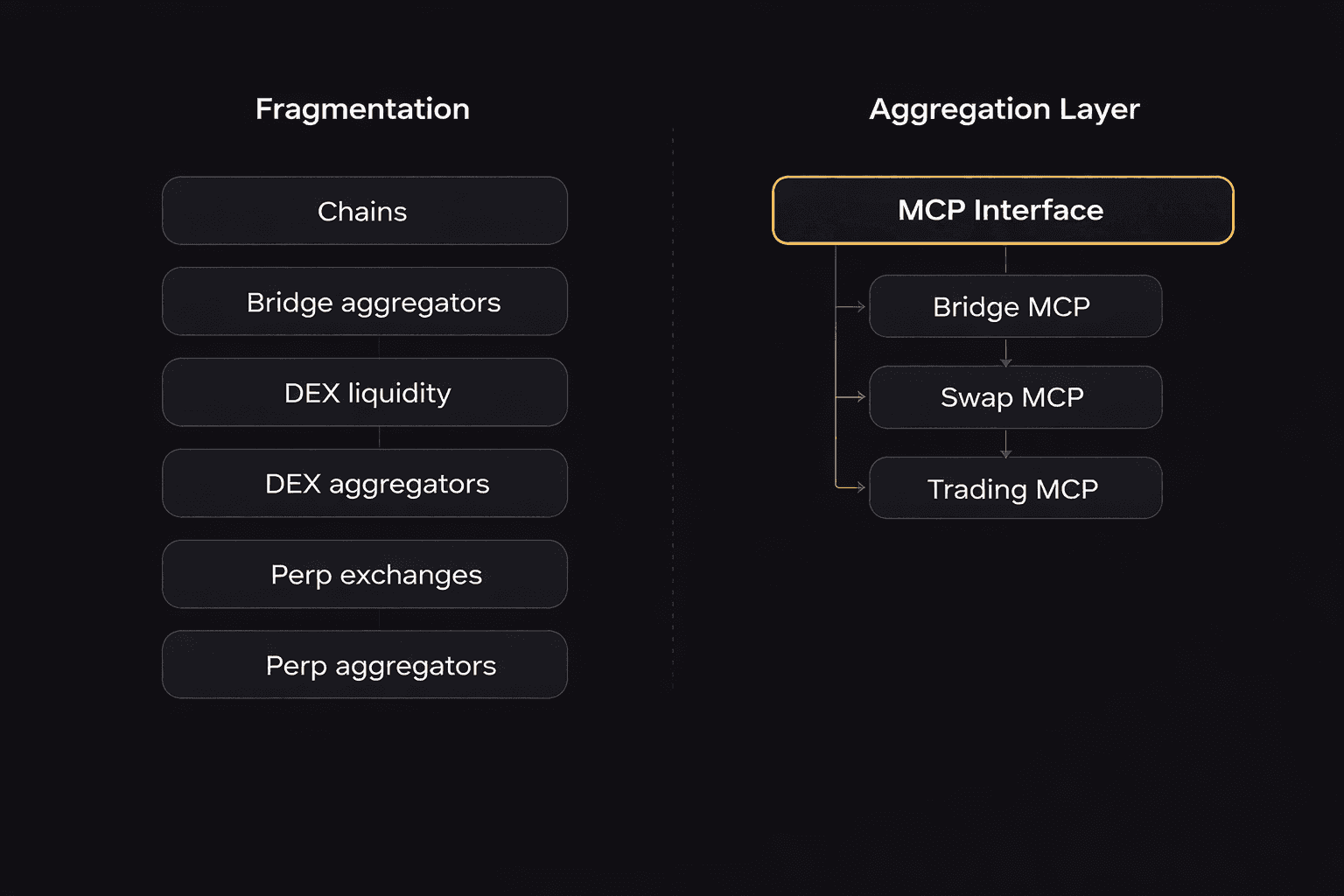
VOOI operates at the aggregation layer of perpetual derivatives, unifying CLOB-based venues into a single trading surface with shared execution and margin semantics. Through its unified API, it provides cross-venue liquidity access, routing, and margin mobility as one coherent interface. These properties align directly with MCP server requirements:
normalized tools
deterministic execution
unified context, and programmable access over abstracted endpoints.
By already implementing these primitives at the perp layer, VOOI functions as MCP-native execution infrastructure for perpetual trading.
Agentic Trading Requires a Unified Market Surface
AI trading systems operate at the level of strategy. They assume:
predictable execution
consistent market data
portable capital
The current perpetual market structure breaks these assumptions. Liquidity and margin remain fragmented across exchanges. Perp MCP solves this by presenting derivatives markets as a single programmable interface. Instead of integrating exchanges, agents connect to the aggregated execution layer. VOOI provides this layer.
One MCP Endpoint for Perpetual Markets
From the agent’s perspective, the perpetual market becomes one tradable surface. Rather than integrating multiple exchanges, the agent connects to VOOI MCP Server VOOI then handles:
venue selection
order routing
liquidity discovery
margin context
Behind the interface may exist many exchanges, but to the agent they appear as one unified derivatives market.
VOOI MCP Server
VOOI is a perpetual DEX aggregator and unified trading API that functions as an MCP server for derivatives markets.
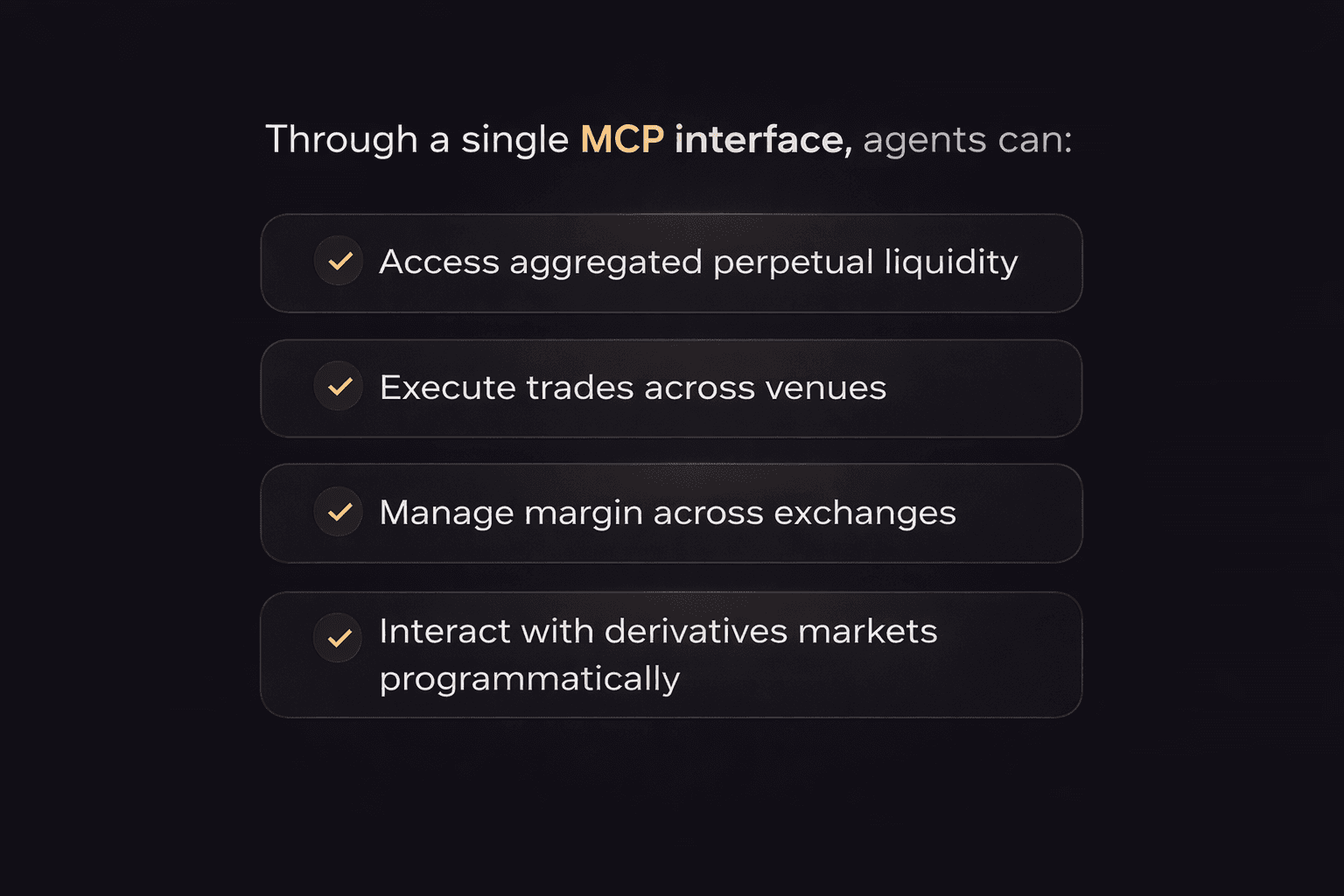
As agentic trading expands, VOOI becomes the execution interface where fragmented perpetual markets converge into one programmable trading surface.
FAQ
What is the VOOI MCP Server?
The VOOI MCP Server is an execution layer for perpetual trading that allows AI agents, trading systems, and developers to access aggregated perpetual futures liquidity across multiple exchanges through a single interface.
Instead of integrating each exchange individually, users connect once to the VOOI MCP server and gain access to cross-venue trading, liquidity discovery, and margin context through a unified API.
This architecture turns fragmented perpetual markets into a single programmable trading surface.
What is MCP in trading?
MCP (Model Context Protocol) is a standard that allows AI agents to interact with external systems using structured tools and APIs.
An MCP server exposes actions that an agent can execute programmatically.
In financial infrastructure, these actions may include:
bridging assets between chains
executing token swaps
managing liquidity positions
trading derivatives
When applied to trading infrastructure, MCP becomes the interface between AI agents and financial markets.
For perpetual trading, this interface must support:
trade execution
margin management
liquidity routing
market context
This makes derivatives markets programmable for autonomous trading systems.
How does the VOOI MCP Server work?
The VOOI MCP Server aggregates perpetual markets across multiple exchanges and exposes them through a unified trading interface.
Instead of interacting directly with individual exchanges, trading agents connect to the VOOI execution layer, which handles:
venue selection
order routing
liquidity discovery
margin context
Behind the interface may exist many exchanges, but to the agent they appear as one unified derivatives market.
Which exchanges are aggregated by VOOI?
The VOOI execution layer aggregates liquidity from multiple perpetual exchanges, including:
Hyperliquid
Orderly
Aster
Lighter
By aggregating liquidity across venues, VOOI creates a single market surface for perpetual trading.
What is aggregated perpetual liquidity?
Aggregated perpetual liquidity means that liquidity from multiple derivatives exchanges is combined into a unified trading interface.
Instead of interacting with each exchange separately, traders and AI agents access one consolidated order book environment.
Benefits include:
better liquidity access
improved execution
reduced fragmentation
simplified infrastructure
VOOI provides this aggregated liquidity through its MCP server.
What does the VOOI execution layer handle automatically?
Once connected to the VOOI MCP server, the system handles several complex trading operations automatically:
Venue selection — choosing the best exchange for execution
Order routing — directing orders to the optimal liquidity source
Liquidity discovery — identifying available liquidity across venues
Margin context — managing margin conditions across exchanges
This allows agents to focus on trading strategy rather than infrastructure management.
How do AI trading agents use the VOOI MCP Server?
AI trading agents connect to the VOOI MCP server as a single execution endpoint for perpetual markets. Through this interface, an agent can:
analyze aggregated perpetual markets
execute trades across multiple venues
manage positions programmatically
monitor risk and margin context
This allows autonomous trading systems to interact with derivatives markets without building custom integrations for every exchange.
Why does agentic trading require a unified market surface?
AI trading systems operate at the level of strategy and decision making.
They assume:
consistent market data
predictable execution
portable capital
Fragmented exchange infrastructure breaks these assumptions.
A unified execution layer solves this problem by presenting derivatives markets as one programmable trading interface.
VOOI provides this unified market surface through its MCP server.

Evan Reed
Technical writer at VOOI